
Try doodle drawings if you feel stressed or need a creative outlet to express yourself. Purposely focusing on pen strokes and patterns to fill your sketchbook fosters a meditative state of mind that keeps you rooted in the present.
If your doodles keep drifting back to the same shapes, leaves, and swirls, it might be time to turn to a better source: the sea. Repeating underwater patterns—waves, scales, shells, bubbles, and seaweed—can turn a blank page into something textured, calming, and surprisingly polished with very little effort.
There’s a reason these shapes work so well: ocean forms are naturally rhythmic. One curved line becomes a wave band. A few tiny circles become a bubble trail. A spiral becomes a shell, and suddenly your page has movement instead of clutter.
In this guide, you’ll learn why ocean-inspired motifs are such low-pressure drawing ideas, how to build quick flow with ripples and wave lines, and how to add texture with scales and shells.
1. Things to Draw: Gold Fish Doodles

If you want to create a beautiful ocean doodle, try using gold pen on black paper. With a stunning contrast, it gives your doodle art a sophisticated and polished look.
Firstly, start with long, easy curves that move in the same general direction. There’s a reason these shapes work so well: ocean forms are naturally rhythmic. One curved line becomes a wave band. A few tiny circles become a bubble trail. A spiral becomes a shell, and suddenly your page is filled with ocean-themed mini drawings.
In the middle, draw two curvy lines to form a shape of the fish. This serves as a focal point of your easy doodle drawing. Later, we will fill the fish doodle with scales and patterns, and add little bubbles.
Some patterns ask for precision. Ocean-inspired ones are far more forgiving. They lean on repetition, loose symmetry, and shapes your hand already knows how to make: small circles, arcs, dots, loops, wavy lines, little swirls.
That makes them ideal when you want doodle drawings without overthinking every mark. A page filled with fish scales, shell curves, drifting kelp, or scattered bubbles starts to look detailed, which is exactly what makes these motifs feel so satisfying.
2. Easy Ocean Doodles

Keep practicing wavy lines, and now you can try another sketchbook idea with smaller, more detailed fish. Firstly, make a few ripple lines on your page. Secondly, fill each space with fish doodles or patterns.
Ripple lines work especially well because they’re forgiving. They don’t need perfect spacing, and they actually look better when each curve has a little personality.
Some can stretch out and stay gentle, while others can bunch closer together as if the water is shifting around a rock or passing over sand. Add big and little dots where the lines cross. This keeps the pattern soft and natural, which makes it easy to fill a page without making it look stiff or overplanned.

Once you have those flowing lines in place, it becomes much easier to layer in smaller details without losing that sense of ease. The bands act like a quiet structure underneath everything else, giving your doodles rhythm while still leaving plenty of room to play. From there, adding scales, shell spirals, and bubble trails is a simple way to introduce texture while maintaining the same underwater charm.
You can treat this wave doodle as your daily exercise. Consequently, add a few new patterns you are trying to learn every day. This way, your full-page doodle doesn’t feel like an insurmountable task. Instead, it becomes your daily doodle habit when you create an easy mini drawing when you have 15 minutes to spare.
3. White Fish Doodle Drawing

Here is another sketchbook idea for you to try: doodle drawings with white and colored gel pens on black paper. Now that you have become an expert in waves and bubbles, you can add other sea creatures, more complicated patterns, and seaweed.
This sketchbook idea may seem simple at first, but the results can be absolutely mesmerizing. The black paper creates a bold contrast that really makes the colors pop, and the gel pens allow for smooth and precise lines that can bring even the most intricate designs to life.
Not only will this challenge your creativity and push you slightly out of your comfort zone, but it will also produce a unique piece of doodle art. And who knows, you may even discover a new style along the way.
So, whether you’re an experienced artist looking to add a new tool to your repertoire or a beginner just starting to explore your artistic abilities, this sketchbook idea is definitely worth a try. Who knows, you may just discover your new favorite medium and create a masterpiece in the process.
So grab your sketchbook, some gel pens, and let your imagination run wild on that black paper. Trust us, you won’t regret it.
4. Doodle Patterns: Simple

Do you have a few minutes to relax and practice doodle drawings? We have a simple exercise with tangles and doodles.
Firstly, divide your sketchbook page or paper with wavy lines. Next, fill each section with different patterns or mini drawings.
Most importantly, you don’t have to be a professional artist to doodle. Treat it as your daily practice to improve hand-eye coordination, fine motor skills, and overall creativity.
One of the main advantages of doodling is its ability to improve hand-eye coordination. By practicing different patterns and shapes, you are training your hand to respond to the movements of your eyes. This can have a positive impact on fine motor skills, which are essential for daily tasks such as writing, typing, and even driving.
But it’s not just physical benefits that doodling offers. It has also been shown to improve concentration and focus. Research has found that doodling can help with information retention and processing, making it a great tool for studying or brainstorming ideas. The act of doodling also allows for a creative flow, which can help to reduce stress and anxiety.
5. Practicing Doodle Drawings with Kids

A single little shape can do a surprising amount of work once you stop treating it like a one-off doodle. Maybe it is a scalloped coral edge, a bubble trail, a tiny shell stripe, or a loose fish-scale curve. Instead of searching for a brand-new idea every few inches, let that small fragment become your starting point and echo it across the page. Repeat it in clusters, stretch it into a border, or scatter it lightly through open areas so the sketch feels connected without feeling stiff.
It also helps to think in patches instead of complete drawings. Fill one corner with short waving plant lines, let another area hold a few rounded coral forms, and drop a narrow band of pebbles or bubbles between them. The page grows in an easy, low-pressure way, and you never have to figure out the whole composition at once. You are just building from one manageable piece to the next.
Also, you can have a joint art practice with the kids by letting them fill in different patterns. From adding simple dots to coloring fish doodle drawings, it can turn into a fun art project without pressure.
6. Seaweed and Bubbles Tangle
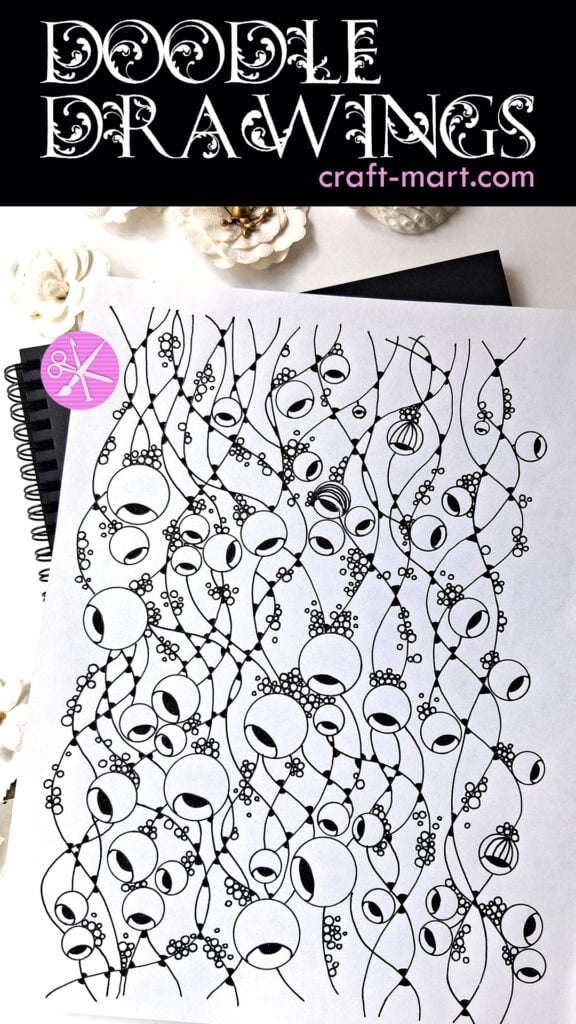
This easy tangle requires a little prep work using a pencil and a circle template. This handy tool with multiple circles of varying sizes is perfect for quick sketching. Furthermore, use it for developing your circle-drawing techniques. In this doodle, you will be practicing drafting and freehand drawing of various circles, triangles, and lines.
Follow simple steps to create similar results. There is something magical in tangle patterns. As you draw lines and circles, a beautiful creation appears on the page. Most importantly, you don’t need special talent or extraordinary skills to practice tangles – just a few minutes a day of your time. As the most calming and relaxing way to draw, it deserves space in your sketchbook, especially if you want to improve your sketching skills.
Materials
- Canson XL Drawing Pads
- SAKURA Pigma Micron Fineliner Pens
- Circle and Oval Stencil Template for Drawing and Drafting
Step 1
Firstly, start by arranging circles on your paper using a pencil and a circle stencil template. Make sure your pencil line is barely visible, as you will later draw over it using an ink pen. Create a composition of different-sized circles by grouping them and spreading them over the page for a balanced composition.
Step 2
Secondly, using a Sakura Micron pen, create bubbles by drawing over the pencil lines. Try to make your circles as perfect as possible. Meanwhile, don’t feel discouraged if they are not, as it is a special exercise to perfect your circle-drawing skills.
Step 3
As illustrated, draw ovals inside every circle. Make them facing different ways to create interest and variety in your composition. Additionally, as shown in the example, fill in the black ovals to create depth.
Step 4
Next, using an ink pen, draw freehand lines connecting your various circles. To add details, draw little triangles whenever your lines cross.
Step 5
Lastly, it is time to practice freehand circle drawing. Obviously, it is easier with smaller circles. Fill your composition with as many smaller circles as you would like to mimic air bubbles attached to seaweed.
7. Sketchbook Idea: Flower Mandala
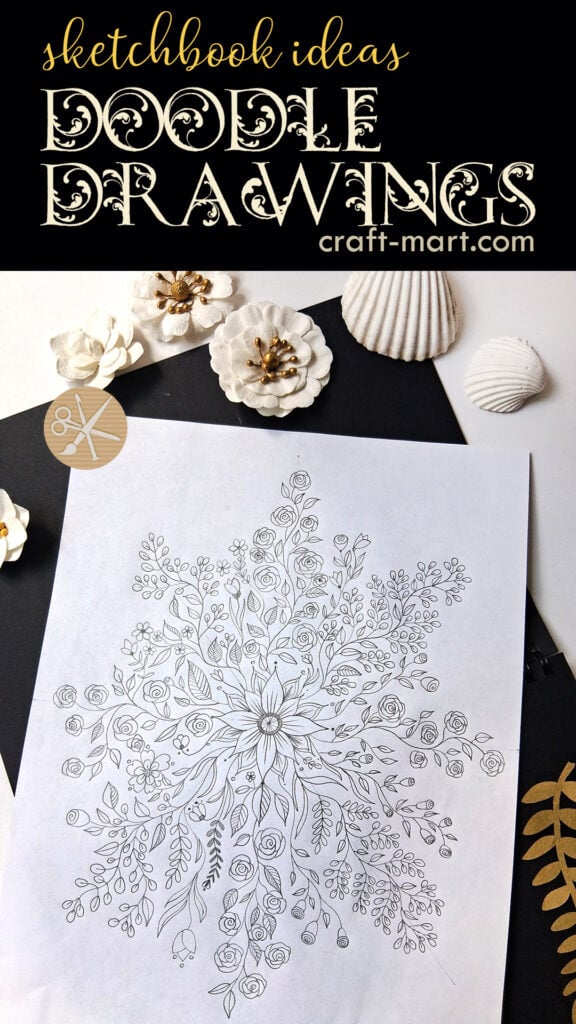
If you want to fill up your sketchbook with easy flower drawings, a mandala is a popular choice. Explore the easy steps to create this composition while practicing easy flower forms, leaves, and branches.
A mandala is a symmetrical geometric design that originated in Hindu and Buddhist cultures. In recent years, it has become a popular choice for artists of all levels due to its intricate yet easy-to-draw nature. By following a few simple steps, you can create a stunning mandala filled with easy flower forms and greens.
For this drawing, you only need a piece of paper and a pencil. Of course, for that perfect finishing touch, you can easily add varying lines using Micron Pens for depth.
Step 1
Mark the geometrical center of the paper – it will be the center of your mandala. In our example, it is the center of the big flower.
Step 2
Using a pencil and ruler, draw very light lines: 1 vertical, 1 horizontal, and 2 diagonal. As a result, you’ll have guide lines for your drawing.
Step 3
Draw the central flower. Whether it is a classic rose, a cheerful daisy, a vibrant sunflower, or an imaginative fantasy flower, the choice is yours. After all, it is your masterpiece, so you are the boss.
Step 4
Draw squiggly lines along the guides you made in step 2. They will represent the branches of your drawing.
Step 5
Start adding details, such as small flowers, leaves, and buds. The vertical and horizontal branches are a depiction of a climbing rose. The diagonal branches represent the filler greens, as in a flower arrangement.
Every part of your flower mandala will be similar but different, which makes it unique and beautiful. Try experimenting with different flower and leaf shapes, or add in your own unique twists to make your mandala truly one-of-a-kind.
8. Ocean Waves Doodles
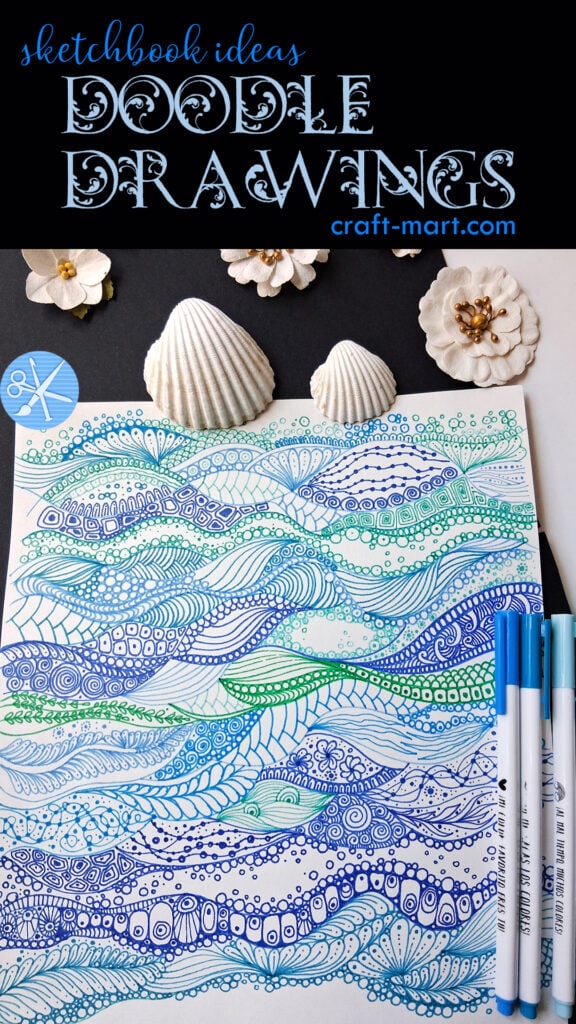
Looking for easy yet creative ways to fill your summer sketchbook? Moreover, doodling is a great way to overcome the fear of a blank page. Many aspiring artists struggle with the intimidating white space of a canvas or paper.
But with doodling, you can start with a simple shape or line and gradually build on it, creating a masterpiece without the pressure of perfection. For example, try ocean waves doodles. Some patterns ask for precision. Ocean-inspired ones are far more forgiving.
They lean on repetition, loose symmetry, and shapes your hand already knows how to make: wavy lines, circles, dots, loops, odd shapes, and spirals. That makes them ideal when you want to draw without overthinking every line.
With just 10-15 minutes a day, your sketchbook page starts to take shape. You fill it with fish scales, shell curves, drifting kelp, or scattered bubbles without putting too much effort. After all, it is exactly what makes these motifs feel so easy to return to.
9. Tangles & Doodles: Silver Fish
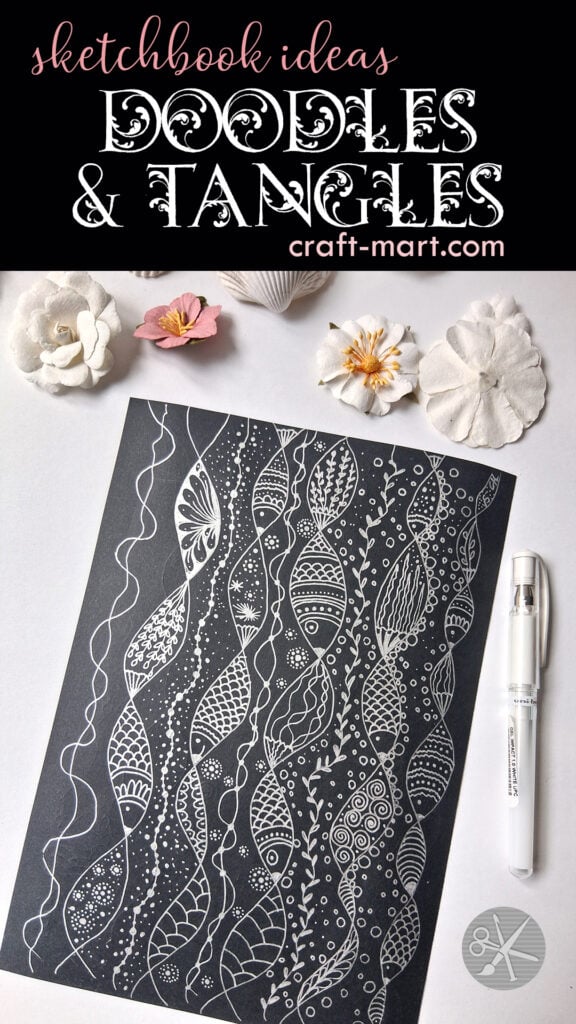
As an artist, there’s nothing quite as thrilling as filling up a blank sketchbook with your own unique creations. But sometimes, inspiration can be hard to come by.
One of the easiest and most fun themes to explore in your sketchbook is transforming wavy lines into charming swimming fish. Not only does it provide a relaxing project, but it also allows you to showcase your doodling skills and unleash your imagination. The best part? It’s a simple concept that anyone can try.
The key to achieving this look is using gel pens on black drawing paper. The contrast between the shimmering silver ink and the dark background creates a stunning effect, bringing the fish to life. Plus, the smooth texture of the gel pens makes it easy to draw fluid, curving lines that perfectly mimic the movements of fish in water.
Start with a few hand-drawn wavy lines. Next, add details like scales, bubbles, and seaweed to create your underwater scene. And don’t be afraid to mix it up and create your own whimsical species of fish – after all, there are no rules when it comes to art of doodles.
Materials for Easy Doodle Art
- Canson XL Black Drawing Pad
- Sakura Gelly Roll Metallic Pens and Sets
- Sakura Gelly Roll Opaque White Pens and Sets
- Canson XL Drawing Pads
- Silver, Gold, and White Gel Pens
- SAKURA Pigma Micron Fineliner Pens
- Circle and Oval Stencil Template for Drawing and Drafting
